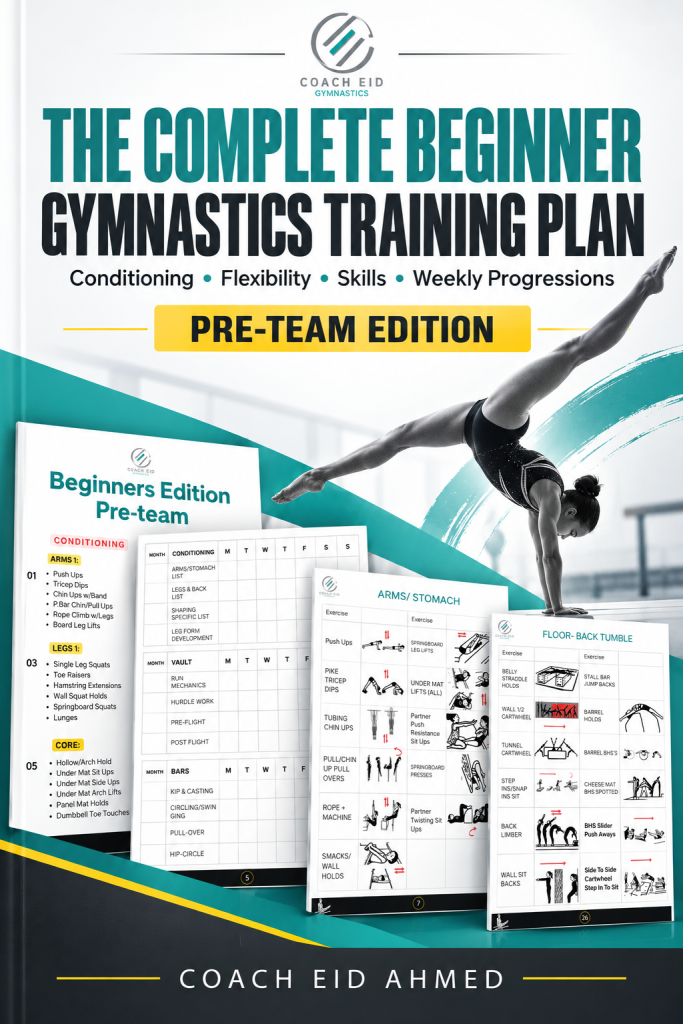
Beginner Gymnastics Training Plan for Coaches | Pre-Team Book
Beginner Gymnastics Training Plan for Coaches | Pre-Team Book
Building strong gymnasts starts long before advanced skills, competitive routines, and medals. It begins with the right physical preparation, correct body shapes, basic movement patterns, flexibility, coordination, and a structured training plan.
The Complete Beginner Gymnastics Training Plan – Pre-Team Edition is a practical coaching guide created to help gymnastics coaches organize beginner and pre-team training with greater clarity and purpose.
Instead of searching for random exercises before every session, coaches can use this book to build a progressive gymnastics program that connects conditioning, flexibility, body shaping, apparatus preparation, and basic skill development.
Whether you are coaching a recreational class, a beginner group, or athletes preparing to join a competitive team, this beginner gymnastics training plan gives you a clear framework for developing the physical and technical foundations every young gymnast needs.

Why Beginner Gymnastics Coaches Need a Structured Training Plan
Beginner gymnastics training involves much more than teaching a few basic skills. Young athletes must gradually develop strength, flexibility, balance, coordination, spatial awareness, and body control.
Without a structured plan, training sessions may become repetitive or disconnected. Athletes may practice complete skills before developing the physical abilities and technical positions required to perform them correctly.
A well-designed beginner gymnastics training plan helps coaches answer important questions:
- What should athletes learn first?
- Which conditioning exercises support each skill?
- How should training be divided between apparatus?
- How can body shapes and flexibility be included?
- What should be repeated throughout the week?
- When is an athlete ready for the next progression?
- How can coaches organize weekly and monthly training?
This book brings these elements together in one practical resource.
What Is Included in the Beginner Gymnastics Training Plan?
The book provides organized exercises, coaching ideas, progressions, and planning templates for beginner and pre-team artistic gymnastics.
The content is designed to help coaches create balanced sessions that develop athletes physically and technically.
Gymnastics Conditioning Exercises
Strength is one of the most important foundations of gymnastics. However, general fitness exercises are not always enough. Gymnasts need specific strength that supports body shapes, hanging, pushing, pulling, jumping, landing, swinging, and holding positions.
The conditioning section includes exercises for:
- Arms and shoulders
- Abdominal and core muscles
- Legs and jumping power
- Back and posterior-chain strength
- Pushing and pulling strength
- Isometric holds
- Bodyweight strength
- Partner-resistance exercises
- Apparatus-based conditioning
These exercises can be selected and adjusted according to the athletes’ age, ability, training experience, and technical goals.
Core Strength and Body Shaping
Correct body shapes are essential for almost every gymnastics skill. Before athletes can perform more complex movements, they must learn how to control their trunk, pelvis, shoulders, and legs.
The book includes exercises that develop:
- Hollow-body position
- Arch-body position
- Tuck position
- Pike position
- Straddle position
- Plank and support positions
- Straight-body alignment
- Core stability
- Postural control
- Tension throughout the body
Teaching these positions from the beginning helps athletes perform skills with better technique and reduces the need to correct deeply established mistakes later.
Flexibility and Mobility Development
Gymnastics requires an appropriate range of motion in the shoulders, hips, spine, hamstrings, and ankles. Flexibility training should therefore be planned rather than added randomly at the end of a session.
The program helps coaches include exercises for:
- Shoulder flexibility
- Back flexibility
- Hip mobility
- Front splits
- Side splits
- Hamstring flexibility
- Ankle mobility
- Bridge preparation
- Gymnastics-specific ranges of motion
Coaches can adapt the exercises and training volume to suit each athlete’s current mobility level.
Beginner Vault Training
Vault development starts with running mechanics, coordination, take-off technique, body alignment, and safe landing—not with the complete vault itself.
The vault section includes preparation for:
- Correct running mechanics
- Hurdle technique
- Springboard take-off
- Pre-flight positions
- Hand support and blocking action
- Post-flight control
- Landing preparation
- Jumping and rebounding ability
These drills allow coaches to develop each phase separately before combining the phases into complete vault skills.
Beginner Uneven Bars Training
Beginner bar training requires grip strength, pulling strength, shoulder stability, body tension, and an understanding of basic swing mechanics.
The uneven-bars section includes exercises and progressions for:
- Pull-over preparation
- Casting
- Glide swings
- Back hip circles
- Kip preparation
- Hanging strength
- Pulling exercises
- Support positions
- Shaping during swings
- Basic circling actions
The drills help athletes develop the strength and movement patterns required for future bar skills.
Beginner Floor Gymnastics Training
Floor exercise is where athletes learn many of the body positions and movement patterns used throughout artistic gymnastics.
The floor section includes progressions and preparation for:
- Forward and backward rolls
- Handstands
- Cartwheels
- Round-off preparation
- Back walkovers
- Backward tumbling
- Back handspring preparation
- Jumping and landing
- Connecting basic movements
- Correct body positions during skills
The exercises break skills into smaller learning stages, allowing coaches to develop confidence and technique progressively.
Beginner Balance Beam Training
Balance beam training improves posture, control, coordination, confidence, and awareness of body position.
The beam section supports the development of:
- Correct walking technique
- Basic balances
- Body alignment
- Jumps and leaps
- Turns
- Mount preparation
- Dismount preparation
- Handstand foundations
- Confidence on a narrow surface
The difficulty of each exercise can be adjusted by changing the beam height, level of assistance, or movement complexity.
Weekly and Monthly Gymnastics Planning
A collection of exercises is useful, but coaches also need a system for organizing them.
The book includes planning templates that help coaches divide training into clear categories and monitor what is being taught throughout the week and month.
Coaches can use the templates to organize:
- Physical conditioning
- Flexibility training
- Body shaping
- Vault development
- Uneven-bars training
- Balance-beam training
- Floor skills
- Skill-specific preparation
- Weekly training priorities
- Monthly development goals
This makes it easier to create balanced sessions and avoid repeatedly training the same areas while neglecting others.
More Than a Collection of Random Gymnastics Drills
Thousands of individual gymnastics exercises can be found online. The real challenge is knowing which exercises to use, when to use them, and how they contribute to long-term athlete development.
This beginner gymnastics training book organizes exercises around clear physical and technical goals.
It helps coaches connect:
- Conditioning with skill development
- Flexibility with technical requirements
- Body shapes with apparatus performance
- Preparatory drills with complete skills
- Daily sessions with weekly and monthly goals
This approach gives every exercise a purpose within the training program.
Benefits for Gymnastics Coaches
Using this structured gymnastics coaching resource can help you:
- Save time when preparing training sessions
- Reduce dependence on random online drills
- Organize beginner and pre-team practices
- Build stronger physical foundations
- Improve athletes’ body shapes and technical positions
- Connect conditioning exercises to gymnastics skills
- Plan training across all four women’s apparatus
- Identify areas that require further development
- Progress athletes more gradually
- Keep a practical reference available throughout the season
Who Is This Gymnastics Training Book For?
This book is suitable for:
- Beginner gymnastics coaches
- Pre-team gymnastics coaches
- Recreational gymnastics instructors
- Women’s artistic gymnastics coaches
- Gymnastics academies and clubs
- Physical education teachers
- New coaches who need a clear starting point
- Experienced coaches looking for additional drills and planning ideas
- Technical directors developing beginner programs
It can be used as a primary planning resource or alongside an academy’s existing gymnastics curriculum.
Can the Program Be Adapted to Different Levels?
Yes. The exercises and drills can be adapted according to the athlete’s age, physical ability, confidence, and gymnastics experience.
Coaches can modify:
- Number of repetitions
- Duration of holds
- Equipment height
- Amount of assistance
- Range of motion
- Drill complexity
- Training volume
- Rest periods
Not every athlete should complete the same exercise at the same difficulty. The coach should select the most appropriate progression and maintain safe supervision throughout training.
Created From Practical Gymnastics Coaching Experience
The book was created by Coach Eid Ahmed, an artistic gymnastics coach and qualified gymnastics judge with more than 14 years of coaching experience.
Its content is based on practical work with gymnasts, physical preparation, skill development, training planning, and competition preparation.
The purpose of the book is not simply to explain gymnastics theory. It is to provide coaches with exercises, progressions, and planning tools they can apply inside the gym.
Build Better Gymnasts From the Beginning
Advanced gymnastics performance is built on basic positions, physical preparation, flexibility, coordination, and consistent technical development.
When these foundations are missing, athletes may struggle with more difficult skills or repeat the same technical mistakes. When the foundations are developed correctly, future learning becomes more efficient and controlled.
The Complete Beginner Gymnastics Training Plan – Pre-Team Edition helps you replace unstructured sessions with a clearer coaching system.
You do not need to create every training session from scratch.
Get the book today and start building stronger foundations, better-organized sessions, and more confident gymnasts.
Frequently Asked Questions
Is this book suitable for new gymnastics coaches?
Yes. The program provides a clear structure that helps new coaches understand how to combine conditioning, flexibility, body shapes, apparatus preparation, and basic skills.
Is the book only for competitive gymnastics?
No. It can be used with recreational gymnasts, beginner groups, and athletes preparing to enter a competitive pre-team program.
Which gymnastics apparatus are included?
The book covers preparation and drills for vault, uneven bars, balance beam, and floor exercise.
Does the book include physical conditioning?
Yes. It includes gymnastics-specific conditioning for the arms, shoulders, core, back, and legs, together with body-shaping and skill-preparation exercises.
Does it include training-planning templates?
Yes. The book contains templates that coaches can use to organize weekly and monthly training priorities.
Can I adapt the exercises to my athletes?
Yes. Coaches can adjust the repetitions, assistance, equipment, training volume, and difficulty according to each athlete’s level.
Is this a complete competitive-level program?
The book focuses on beginner and pre-team development. Its purpose is to build the physical and technical foundations athletes need before progressing to higher competitive levels.